Unattended by design
Tickets in.
Reviewed pull requests out.
Label a ticket in Linear, Jira, GitHub or Slack. Marlow builds it in a sandbox, reviews and tests its own diff, and opens the pull request. Nobody is at a keyboard.
- Works from the tracker you already use
- Self-reviewed, tested and risk-checked before you look
- You set the merge gate, per project
- Priced per run — tokens at provider cost
The same five stages, every time
A ticket starts itself — nothing to open, nobody to prompt. Every stage is durable, and every stage leaves a row behind.
- 01
Webhook
POST /api/webhooks/linear/org-… · HMAC verified
- 02
Workflow
label match · or LLM triage
- 03
Dispatch
task queue: marlow · workflow.start()
- 04
Sandbox
clone repo · install deps · run agent
- 05
Pull request
open PR · post status to ticket source
Writing the diff is the easy part
Any model can write a diff. The product is everything between the last line it writes and the moment it asks for you.
Every run passes these gates, in this order. The one below is a sample.
- review
It reviews its own diff before you do
In-pipeline review, then your test command, then a risk verdict on the branch.
queued - safety
A migration gets executed, not just read
Applied to a disposable copy of your schema before anyone trusts the SQL.
queued - merge
The last gate is always yours
Each project picks its policy — open the PR and stop, or wait for CI and merge. A parked run costs nothing.
queued
- Secrets that never sit in plaintext
- Encrypted per project, decrypted inside the sandbox at the point of use.
- A run's spend is a number, not an invoice line
- Every model call is priced at the provider's own rate as it happens and written to the run.
You can prove what it did.
Every decision is one row in an append-only ledger. Six months on, “why did it touch that file” is a query, not an argument.
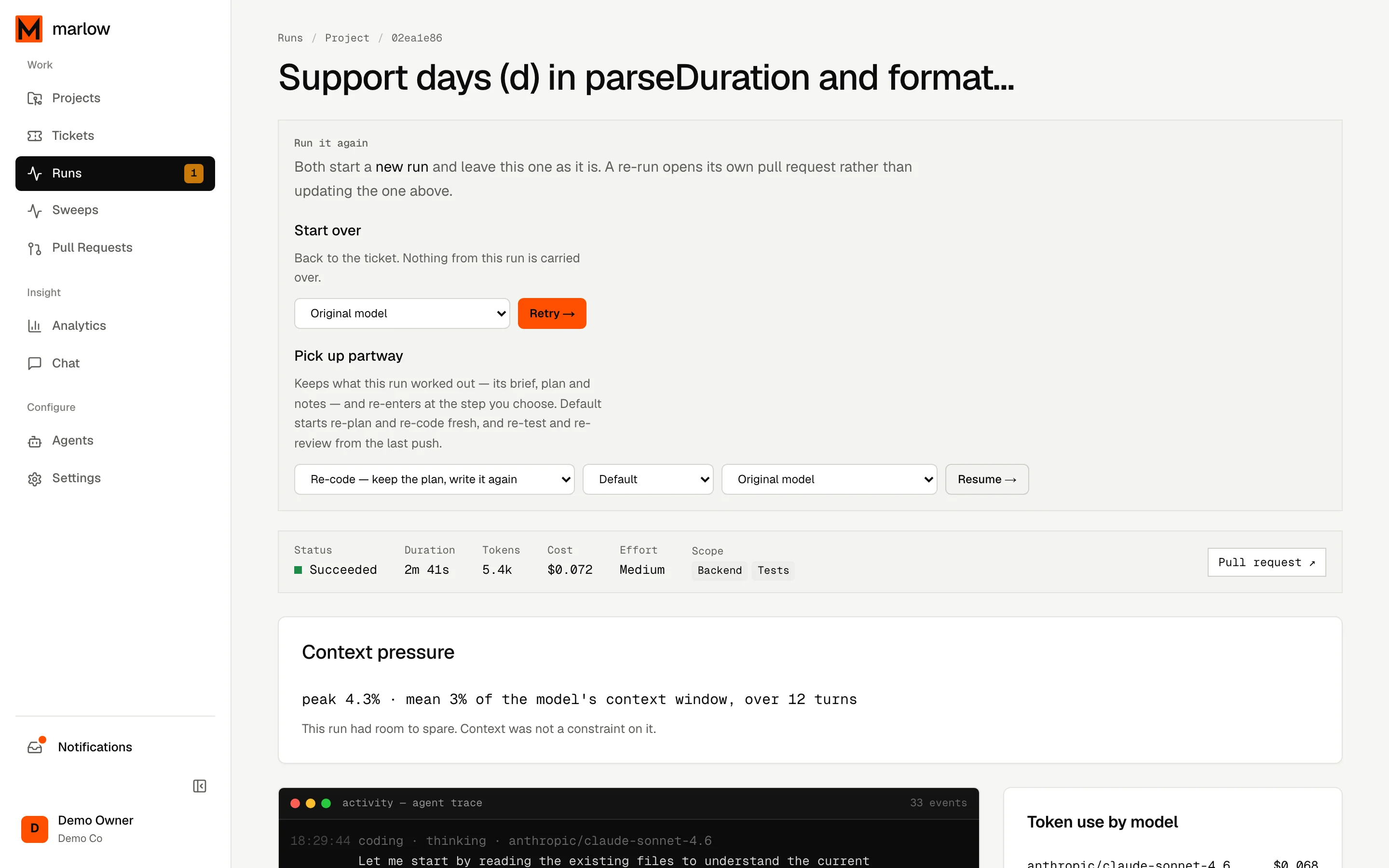
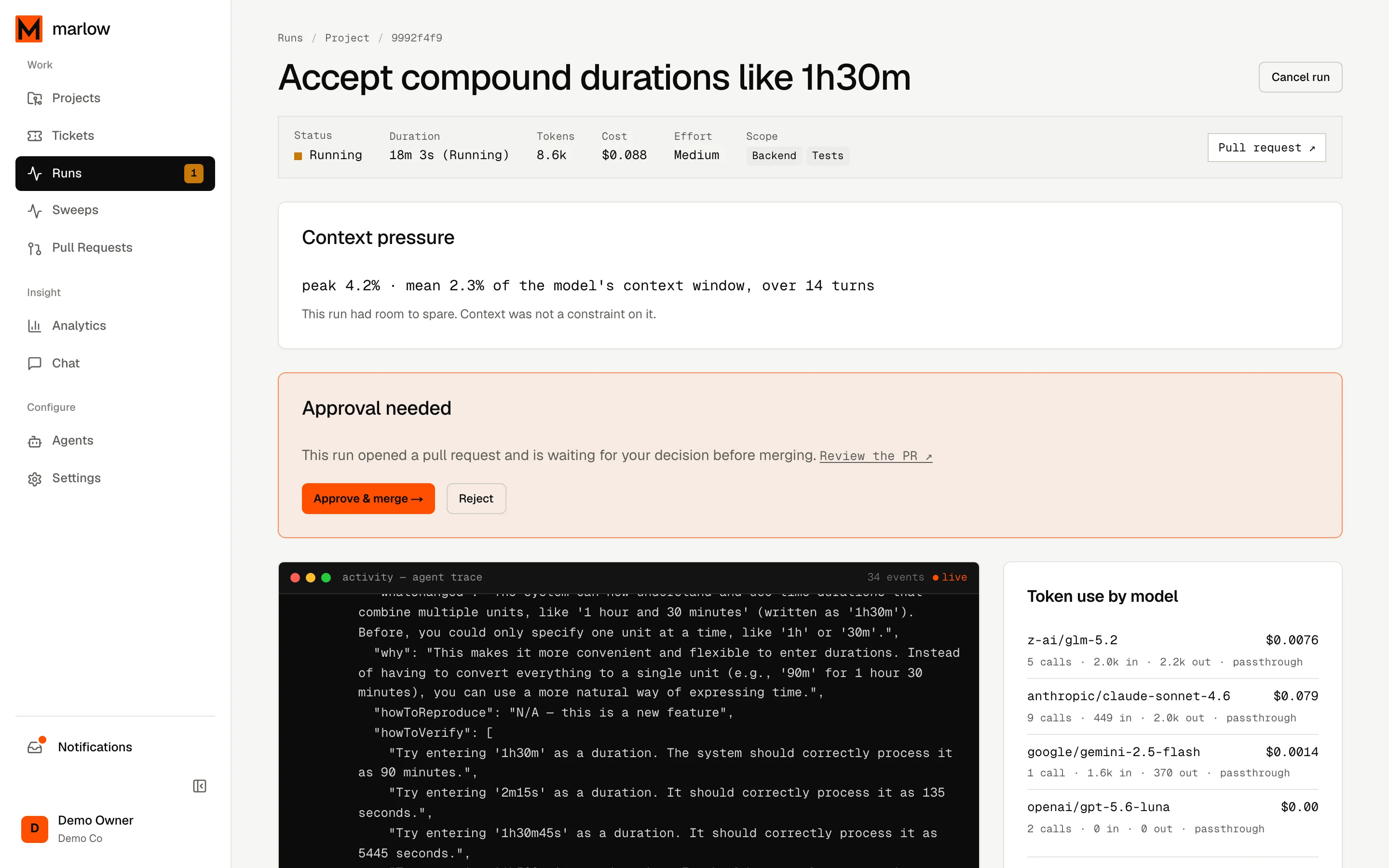
Run fifty is not run one
A failed run is tuition — and tuition is not paid twice.
- write
A failed run leaves a lesson
Every failure distils to one compact lesson on the project.
- recall
The next run reads it first
It rides a capped block of the next run's prompt.
- retire
What stops helping is dropped
Recalled by runs that still fail, a lesson loses its place. It forgets on purpose.
- graduate
The durable ones become a pull request
Repeat lessons distil into a LEARNINGS.md, proposed as a pull request you merge.
- its memory is a file in your repo, merged by you.
Not everything a team needs is a feature
Most start from a label on the ticket. Review and CI fixes start from the pull request.
- coding
- Work the small stuff
- The export nobody has added, the endpoint that needs pagination.
- verify-build
- Prove the build still boots
- Clone, install, build, tear down — on a schedule.
- prd
- Turn a one-line request into a spec
- One line in, a spec out, against the repository's constraints.
- intake
- Ask the questions a bad ticket is missing
- Asks for what a thin ticket is missing, before anything is spent.
Four of the 6 never write a feature.
It is not a faster editor
Editor tools make the hour at the keyboard better. Marlow works the queue when nobody is at one.
attended
An editor assistant, Cursor, Claude Code — Marlow does not replace them.
unattended
Marlow. Hosted, or in your own network on your own provider keys.
The real question: what happens to the forty tickets nobody is going to start?
Primary
Engineering teams with more backlog than reviewers
Label the work nobody has time to start. It comes back as a pull request that has already been reviewed once — and anyone on the team can file the ticket.
Marlow fits a team that has
- A tracker it actually uses
- CI
- A habit of reviewing pull requests
Also
Agencies and studios
Fixed-price delivery makes cost per ticket the margin question. Per-run pricing makes a client’s work cost a number, not a monthly guess.
How agencies use MarlowWhat you send, what you get back
No SDK, nothing to install in your app. Post a signed webhook, declare what the project runs.
- Sources
- Linear
- GitHub
- Jira
- Slack
- Webhook
- GitLabplanned
- Bitbucketplanned
The ticket's label picks the workflow; anything unlabelled goes to triage.
- Outputs
- GitHub PRs
- Slack notifications
- GitLab merge requestsplanned
- Bitbucket pull requestsplanned
Pull requests open under your own bot account, not ours.
- Storage
- S3-compatible
- SFTP
Logs and artefacts land on storage you own.
- Models
21 models across 7 vendors
- OpenAI
- 7
- Anthropic
- 6
- 2
- Perplexityvia OpenRouter
- 2
- xAI
- 2
- Qwenvia OpenRouter
- 1
- Z.AIvia OpenRouter
- 1
You bring the keys, so tokens land on your provider bill — Marlow prices the harness, not the models. For the routed rows, the key you bring is OpenRouter's.
keys you can bring
- Anthropic, OpenAI, Google, xAI, OpenRouter keys
- Amazon Bedrock
- OpenAI-compatible endpoints
- your own Cloudflare AI Gateway
Send tickets from anywhere. The body carries only the ticket; repeat deliveries collapse on (source, externalId).
POST /api/webhooks/tickets/{sourceId}
X-Marlow-Signature: sha256=78c3…b201
Content-Type: application/json

{
  "externalId": "TASK-2841",
  "externalUrl": "https://internal.acme.io/tasks/2841",
  "title": "Add CSV export to billing dashboard",
  "body": "Customers want a one-click export from the invoices view…",

  // The label is what picks the workflow.
  "labels": ["coding", "billing"],

  "author": {
    "email": "morgan@acme.io",
    "displayName": "Morgan Vale"
  }
}
The questions asked by whoever has to approve this
Not everyone who must say yes files tickets.
- Where does the code run?
Its own container, on a sandbox image the project sets. The volume dies with the run.
Per project
- Whose model keys are used?
Yours. One per organisation and vendor, encrypted, re-probed daily — a revoked key surfaces in settings, not a failed run.
/settings/provider-keys
- What is the record?
One append-only row per mutation: organisation, actor, action, target, payload, time.
/settings/audit
- What stops it spending?
A spend ceiling and a dispatch pause, refusing even a hand-started run. Cost is recorded per run and model.
/settings/limits · /analytics/costs
- What can each person do?
Two roles, owner and member — no finer-grained permissions and no certification yet.
/settings/members
- Can it run in our network?
A Helm chart and a compose file. Nothing durable on local disk.
Self-hosted
What whoever signs off on spend will ask
Your numbers, already in the console.
- What shipped?
Pull requests merged per day, against the window before.
/analytics
- How long did it take?
Ticket created to merged code, with Marlow's working time split from review, CI and waiting. Unmerged tickets are counted, not dropped.
/analytics
- What did it cost?
Model spend per merged pull request, and by model and day.
/analytics · /analytics/costs
No before-Marlow comparison: nothing measured one.
Pay for runs, not for seats
A run is one ticket worked to a terminal state. Free fits a team of three; every paid tier has unlimited seats.
Free needs no card. Paid plans are bought from the console’s billing page, monthly or yearly, and can be changed or cancelled there.
- Free$0forever
Enough real tickets to know whether it works on your repository.
- Runs included
- 50 / month
- Concurrent runs
- 1
- Additional runs
- dispatch stops
- Paid yearly
- —
- Token markup
- None
- Starter$49per month
Past Free, not ready for $99.
- Runs included
- 100 / month
- Concurrent runs
- 2
- Additional runs
- $0.35 each
- Paid yearly
- $490 / year
- Token markup
- None
- Team$99per month
Routine work through the queue.
- Runs included
- 500 / month
- Concurrent runs
- 4
- Additional runs
- $0.35 each
- Paid yearly
- $990 / year
- Token markup
- None
- Scale$499per month
Many repositories, one queue.
- Runs included
- 3,000 / month
- Concurrent runs
- 16
- Additional runs
- $0.25 each
- Paid yearly
- $4,990 / year
- Token markup
- None
Nothing that keeps you safe is an upsell.
A platform that meters its own safety features is not one to trust.
- One sandbox per run, with scoped secrets
- The append-only audit ledger
- Workflow selection, triage and custom agents
- Review, CI verdict and the merge gate
- Tokens at provider list price — no markup, ever
- Unlimited projects and repositories
Self-hosting and SSO · talk to us
Prices exclude VAT · Pay yearly for two months free
Start on Free
Start with one boring ticket.
Connect a repository and send it something you have been putting off. Set the gate to “open a pull request and stop” — the worst case is a branch you close.
No card required · nothing to cancel · read the FAQ